Madagascar Bourbon vanilla dominates the conversation. It is the default choice in product
specs, the most familiar name on supplier lists, and the benchmark that most US food
manufacturers measure every other vanilla against.
But for procurement teams and product developers who have explored beyond Madagascar,
Indonesian Planifolia vanilla beans consistently emerge as a compelling alternative — one that
offers a distinctly different flavor profile, highly competitive pricing, and a more stable year-round
supply from the world’s second-largest vanilla-producing nation.
This guide covers everything a B2B buyer needs to know about Indonesian Planifolia vanilla
beans: what they are, how they compare, which applications they are best suited for, and what
to look for when selecting a wholesale supplier.
Indonesia’s Planifolia Vanilla Beans Role in the Global Market
Indonesia is the world’s second-largest producer of vanilla, with an estimated annual production
exceeding 2,300 tonnes — behind only Madagascar. The country’s position along the equator,
combined with its volcanic soil, tropical rainfall, and extensive agricultural heritage, makes it one
of the most naturally suited environments for Vanilla planifolia cultivation on the planet.
Indonesian vanilla production spans several regions — West Java, Bali, East Java, Sulawesi,
Sumatra, and Papua — each contributing slightly different soil and microclimate influences to
the final bean character.
The Flavor Profile: What Makes Indonesian Planifolia Distinct
This variety is often described in contrast to Madagascar Bourbon — but framing it
purely as an alternative misses the point. Indonesian vanilla has its own distinct character,
driven by specific curing methods, soil composition, and local climate that produce a flavor
profile Madagascar beans simply cannot replicate.
Tasting Notes
- Bold and intense: A stronger, more assertive vanilla presence than Madagascar
- Earthy and woody: Deep, grounding base notes with a slight smokiness from traditional
sun-curing - Creamy undertones: A smooth, round vanilla finish beneath the earthy character
- Slight fruity notes: Subtle raisin and fig-like accents, particularly in beans from
Sulawesi and Java - High vanillin content: Among the highest of any global origin — ideal for extract
production and flavoring at scale
This boldness is what makes Indonesian Planifolia the preferred choice for applications that
require a strong vanilla signal — chocolate, coffee, caramel, and extract manufacturing —
where it competes with, and often outperforms, Madagascar beans on depth and yield.
Physical Characteristics
- Moisture content: 28-30% (grade A) 15-20% (grade B) — lower than Tahitian, more stable for long shelf life
- Bean length: 16-20 cm (Grade A gourmet) grade B 14-20cm
- Vanillin content: High — particularly well-suited for extract production
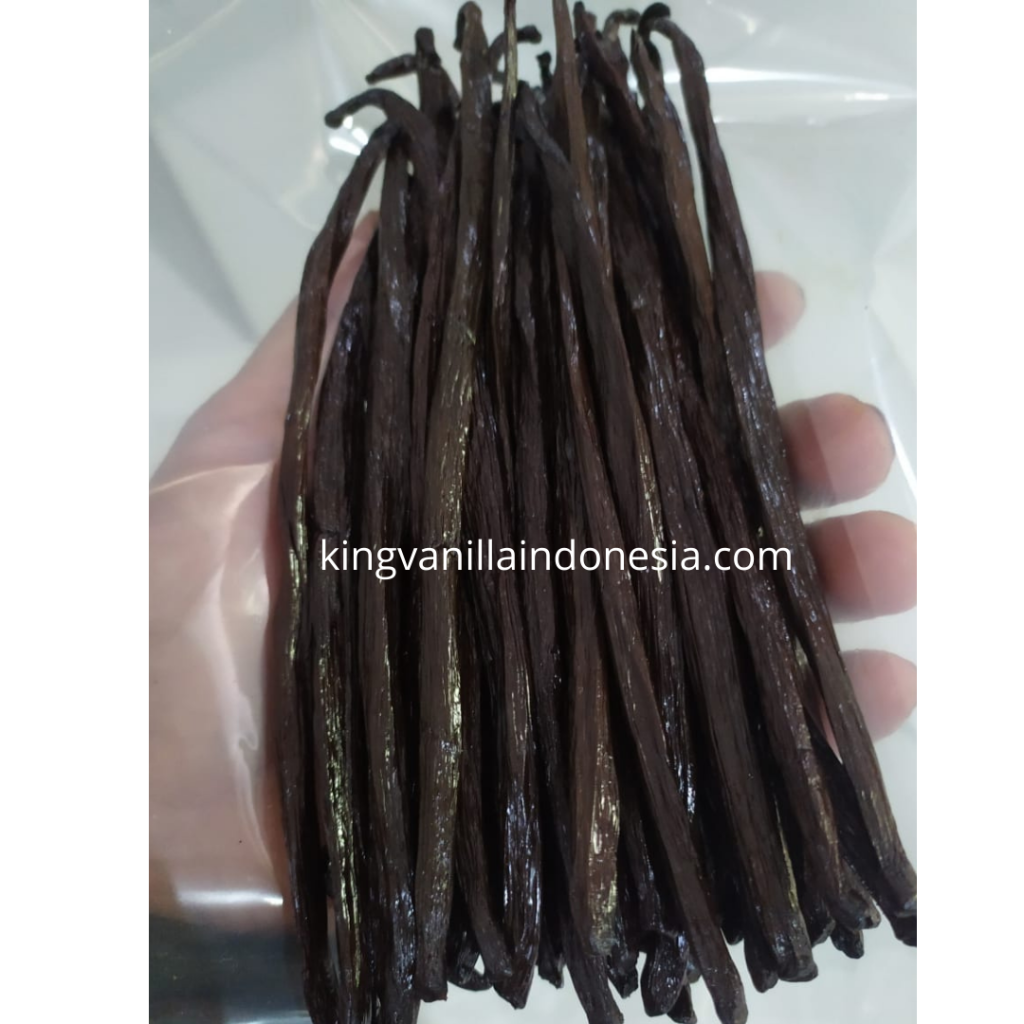
- Appearance: Dark brown to near-black, lean pods with rich caviar yield
Best Applications: Where Indonesian Planifolia Excels
Understanding where Indonesian Planifolia delivers the strongest ROI helps buyers make more
precise sourcing decisions across product lines.
- Vanilla Extract Manufacturing
High vanillin content makes Indonesian Planifolia one of the most extract-efficient vanilla origins
globally. Extract producers benefit from a stronger flavor yield per unit weight — especially
relevant for Grade B (extract-grade) bean sourcing at scale. The bold, complex profile also
supports the development of distinctive house-blend extracts that stand apart from commodity
Madagascar-based products. - Chocolate and Confectionery
Indonesian Planifolia’s earthy, woody character with fruity undertones integrates exceptionally
well with dark and milk chocolate formulations. The assertive vanilla note cuts through cocoa’s
richness without being overwhelmed — a property that has led many premium chocolate
makers to prefer Indonesian beans as a complementary or primary flavoring agent. - Ice Cream and Frozen Desserts
- For ice cream manufacturers, Indonesian Planifolia delivers a bold vanilla signal that holds up
well after freezing and fat emulsification. The higher vanillin content ensures the vanilla
character remains prominent in the final product — a critical factor for mass-market vanilla ice
cream where flavor intensity directly impacts consumer satisfaction. - Coffee and RTD Beverages
The woody, slightly smoky depth of Indonesian vanilla pairs naturally with coffee’s roasted
notes. Beverage manufacturers — including cold brew, RTD coffee, and premium instant coffee
brands — use Indonesian Planifolia to add authentic vanilla complexity without the sweetness of
synthetic vanilla that can conflict with coffee’s bitterness. - Large-Scale Food Manufacturing
For food manufacturers operating at high volume, Indonesian Planifolia’s combination of bold
flavor, competitive pricing, and reliable large-scale supply makes it the most commercially viable
natural vanilla origin available. Its flavor intensity allows for lower usage rates relative to weaker
vanilla sources, improving cost-per-unit economics across the production line.
Sourcing Indonesian Planifolia Vanilla from King Vanilla
Indonesia
King Vanilla Indonesia supplies Grade A and Grade B Indonesian Planifolia vanilla beans direct
from our own farms in West Java to buyers across the United States. Every bean is grown on
our land, traditionally cured, and inspected before export — giving buyers full traceability and
consistent quality across every order.
- Farm-direct supply: Grown and processed on our own farms — no intermediaries,
complete traceability - Consistent quality: Hand-selected, multi-stage inspection, vacuum-sealed for peak
aroma and moisture preservation - Both grades available: Grade A for gourmet culinary and retail; Grade B for extract
manufacturing at scale - US market experience: Established export logistics to the United States with full FDA-
compliant documentation - Competitive wholesale pricing: Direct farm sourcing eliminates middleman costs —
passing savings to the buyer - Year-round supply: Reliable inventory planning with consistent lead times
Frequently Asked Questions
Q: Why is Indonesian vanilla priced more competitively than Madagascar?
Indonesia is the world’s second-largest vanilla producer with a well-established export
infrastructure and lower production costs than some other origins. Direct farm-to-export sourcing
further reduces intermediary costs. The result is a competitively priced product with no
compromise on quality — particularly for buyers requiring large volumes.
Q: Is Indonesian vanilla suitable for making vanilla extract?
Yes — Indonesian Planifolia is one of the most extract-efficient vanilla origins available, due to
its high vanillin content. Grade B (extract-grade) beans are specifically optimized for extraction,
offering strong flavor yield at a lower price point than gourmet Grade A. Many US extract
producers use Indonesian beans as their primary or secondary vanilla source.
Q: Can Indonesian Planifolia replace Madagascar vanilla in existing
formulations?
In most applications, yes — though the flavor profile is noticeably bolder and earthier. We
recommend requesting a sample for side-by-side evaluation in your specific application. For
chocolate, coffee, and extract applications, many buyers find Indonesian Planifolia performs
equally well or better. For delicate cream-based pastry applications, some formulators prefer to
blend Indonesian and Madagascar beans to balance intensity with sweetness.
Q: What certifications do you provide for US import compliance?
We provide phytosanitary certificates, certificates of origin, and full export documentation
compliant with US import requirements. We can also accommodate additional certification
requests — including halal certification and organic documentation where applicable. Contact us
to discuss your specific compliance requirements.
Q: What is the minimum order quantity?
We accommodate a range of order sizes — from sample quantities for product development
through full commercial bulk orders. Contact us directly with your volume requirements for a
tailored quote and lead time estimate.